

I tested this gadget that makes Nintendo Switch games look way better on 4K TVs
I tested this gadget that makes Nintendo Switch games wait fashion better on 4K TVs
If you're looking for a gift for a Nintendo Switch gamer in your life, this could be information technology. And I know because I've tested it.
Metroid Dread is easily one of the best Nintendo Switch games to come up out in 2021. The fast side-scrolling activity coupled with its deep labyrinthine globe makes for an engaging experience throughout. Unfortunately, due to the aging hardware of the Nintendo Switch, developer MercurySteam had to brand some graphical cuts to ensure the game could run at a smooth 60 fps.
This meant lowering the resolution downwardly to a measly 1600x900 when docked with zero anti-aliasing. On larger 4K televisions, this leads to blurry textures and jagged edges, not something indicative of a major 2021 release.
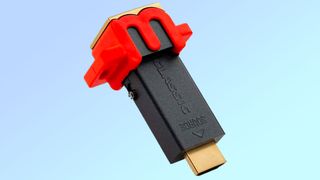
I personally did not feel the game this way. And no, I didn't emulate the game on PC equally some others did. My gaming setup incorporates the mClassic ( $99 on Best Buy ), a small HDMI upscaler made by U.S.-based hardware manufacturer Marseille Inc.
The device looks like an unassuming streaming stick with a giant "grand" logo sticking out the back. Information technology connects to the back of a Nintendo Switch, or whatsoever other device with an HDMI output, and upscales approachable video while as well adding an antialiasing layer on pinnacle. In my setup, I have information technology at the output end of an HDMI switch then that all my retro systems tin can go a minor graphical crash-land.
I had been using the mClassic for most a year on my 55" LG OLED C9 Tv set. Information technology'due south an excellent TV, but with a 3840 x 2160 resolution, lower scale content can end up looking blurry. When playing games like Animal Crossing: New Horizons or Splatoon 2, my eyes grew tuned to the smoother edges the mClassic was helping output.
It was while I was at a friend's house that I noticed how blurry and jagged Switch games looked on a 4K display minus the mClassic. My friend besides sports an LG OLED, making it an fifty-fifty comparison for my eyes.
Upon seeing non-mClassic gameplay, I told him to consider getting the atomic blood-red and black device. But he declined, saying he didn't play the Switch oftentimes plenty and that the $99 toll tag wasn't worth it for such a subtle change in quality. I couldn't arraign him. To heap on an actress $99 toll to a $300 gaming system is a lot. Notwithstanding, the mClassic is often on sale for $x to $twenty off.
Either way, the difference for me when playing Metroid Dread was pregnant enough to where side-past-side comparisons had to be made.
Beneath is a video of Switch gameplay comparison the mClassic when both on and off. The effect is most noticeable on a large 4K idiot box, but the video should demonstrate what I hateful. Be certain to zoom in and picket it in 1080p.
The start of the video shows my Nintendo Switch OLED'due south bill of fare screen. Have a look at the logos for No More Heroes: Travis Strikes Again. The lettering when the mClassic is off is noticeably blurrier versus when it's on.
The next scene shows Samus Aran in her send with the camera zooming in closer to her helmet. Here, if yous wait at the edges of her visor when the mClassic is off, there's a shimmering event taking place, almost as if the pixels are dancing. This is due to the lower resolution and lack of antialiasing essentially showing the corners of each pixel. When the mClassic is on, the effect is less noticeable.
Just less noticeable does not mean entirely unnoticeable. The mClassic only bumps the resolution to the next output value. This means that a 720p bespeak can only go upwards to 1080p. A 1080p signal can only go up to 1440p. The mClassic doesn't magically postal service-process an prototype from 720p to 4K. Doing so would likely crave much more horsepower and special upscaling algorithms.
A later scene shows Raven Beak, the main antagonist in Metroid Dread, property Samus by the throat. We've added an image slider beneath for like shooting fish in a barrel comparisons. Here, if you look at the edges of Samus' calves and hips, her armor doesn't wait fully round and smooth. You can also come across more than jagged edges around her shoulder pads and at the top of her helmet. For the best results, endeavour zooming in on your phone or computer.
A similar upshot can exist seen in this scene, with Samus collapsed on the floor after her run into with Raven Beak. Again, zoom in for all-time results.
Here, there's a general blurriness to Samus. Expect at the areas in which blueish meets with white on her armor. There'south a slight smear to the image. And accept a look at the orange glow from her arm cannon. When the mClassic is off, the calorie-free source looks angular, equally if it were from a 3DS game.
When moving the slider below to the "on" position, there'due south a clear resolution bump effectually Samus. Colors popular a little more and there's overall greater clarity. Plus, the orangish lights from her arm cannon don't smear into the remainder of her weapon.
Jagged edges are especially noticeable in the slider below, where Samus is seen examining her suit after the Raven Beak encounter. Pay attention to the round areas of Samus' armor, like her shoulder pads and helmet. The silverish lightning commodities-like image on her shoulder pads look noticeably sharper with the mClassic on.
And in this gameplay scene below, Samus looks blurrier with the mClassic off versus when information technology's on.
Hopefully the clip and image sliders above assist better demonstrate what the mClassic can do for lower resolution content. When it comes to bodily gaming, I noticed zippo lag or latency issues. Metroid Dread, Splatoon 2 and Super Smash Bros. Ultimate feel every bit smooth with the mClassic off as it does with information technology on.
Whether the mClassic is worth the $99 (or occasional $79) price tag comes down to individual preference. I bought it for $90 earlier this year, and accept noticed improvements to many classic games, such as Wii titles running on Wii U. In this case, the Wii U does its own internal upscaling of Wii games, and then the mClassic adds another upscaling layer on top. Playing the Wii game Wario Ware: Smoothen Moves on Wii U with mClassic looks remarkably brighter and cleaner versus playing on a Wii solitary.
For some, the cost of the mClassic is too high considering the improvement to picture quality. For others, peculiarly videophiles such as myself who are constantly looking for the best quality output, it's a must-have.

Source: https://www.tomsguide.com/hands-on/in-lieu-of-switch-pro-the-mclassic-makes-metroid-dread-look-better-on-a-4k-tv
Posted by: joestagazen.blogspot.com
0 Response to "I tested this gadget that makes Nintendo Switch games look way better on 4K TVs"
Post a Comment