

How To Hard Reset Sql Reporting Service
SQL Server Reporting Services is one of the most popular components of SQL Server, only it has always been surprisingly difficult to get from 1 place all the basic facts you lot need to get upwardly and running from scratch, to the point of producing reports. Here Kathi Kellenberger quickly describes the basics of SSRS before showing how to build quick, elementary reports.
SQL Server Reporting Services Basics: Building SSRS Reports
SQL Server Reporting Services (SSRS) is a server-based reporting platform that allows the states to create and manage a broad variety of unlike types of report, and deliver them in a range of formats. Nosotros can create basic reports containing tables and graphs, or more complex data visualizations, using charts, maps and sparklines. Our reports can draw their information from SQL Server databases, just too from other relational database such as Oracle, and other types of multi-dimensional or XML-based data sources such as SQL Server Analysis Services, Teradata, or Parallel Information Warehouse.
We tin present our finished reports directly from the Reporting Services website, called Study Director, or users tin can view them directly within their web- or Windows-based applications. Terminate users can run reports on demand or schedule them equally subscriptions. We tin can also install SSRS so that the reports run from SharePoint. This commodity is the outset in a serial that will provide in-depth coverage of the basics of written report development with SSRS:
- Building SSRS Reports (this commodity) – covers the nuts of SSRS, demonstrates how to build quick, uncomplicated reports, and will familiarize yous with the basic Study Designer environs
- Customizing SSRS Reports (Part 2) – covers use of custom and aggregate functions, sub-reporting, the matrix command, drill-downs, and sorting.
- SSRS Visual Controls (Part 3) will take an in-depth wait at the SSRS visual controls, notably the chart command.
- Deploying SSRS Reports (Part four) walks you through deploying reports and the Study Builder tool
The report development examples in this series volition work for SSRS 2008 R2 through 2012. Most of the examples will as well work for 2008, and whatever I'll call out any exceptions. If you lot are still using SQL Server 2005, please refer to Steve Joubert's original SSRS series, upon which the example in this series are based.
SSRS through the ages
SSRS has been around for over 10 years, start shipping equally an "add together-on" for SQL Server 2000, then fully integrated into SQL Server 2005. I outset saw it demonstrated at the 2003 PASS Summit, and had the Beta version installed and running within a couple of days of getting back to piece of work. Back in 2003, SSRS caused great excitement equally information technology fabricated available, for the outset time, built-in reporting capabilities for SQL Server. If y'all owned SQL Server, y'all owned SSRS.
Since its integration into SQL Server 2005, Microsoft has made a number of improvements and added many new features. It had a big overhaul in 2008 and acquired a agglomeration of new features with 2008 R2 including:
- The tablix data region which allows usa to convert a written report area from a table to a matrix and dorsum again
- Enhanced chart, and new estimate, information regions (thanks to the Dundas acquisition)
- Consummate redesign of the Report Designer including a new Group Pane
- Formatting of text elements, non simply at the textbox level
- Performance enhancements
- 2008 R2: KPIs, maps, sparklines, new functions, published Report Parts, and more than
Since then, the basic features of the standard SSRS reporting tool haven't changed. Still, with SSRS 2012, Microsoft added Power View, providing a new way to create reports and geared towards concern users. Ability View is part of SSRS when installed in SharePoint integrated manner or every bit an add-in for Excel 2013. SQL Server 2014 was recently released, and there were no developer feature enhancements with this release.
SSRS Architecture
This series of manufactures focuses on the development of reports. Keep in mind that SSRS tin can be deployed to SharePoint, but this serial of article just covers the native deployment architecture.
An SSRS deployment must exist associated with a SQL Server example. On the example will be two databases, past default:
-
ReportServer– contains the study definitions, configuration, history, security of deployed reports and more -
ReportServerTempdb– much liketempdb, it is used as a workspace for building reports and doesn't maintain any objects permanently.
Nosotros will also demand a location for the Report Server Web Service, which tin be on the aforementioned server every bit the databases, equally in the simple deployment architecture shown in Figure 1, or on a dissimilar server. On whichever server we choose, we will have access to a Report Manager website that allows us to deploy and manage the reports. End users tin can run reports from Report Manager, create subscriptions, and publish their own reports if they take permission.
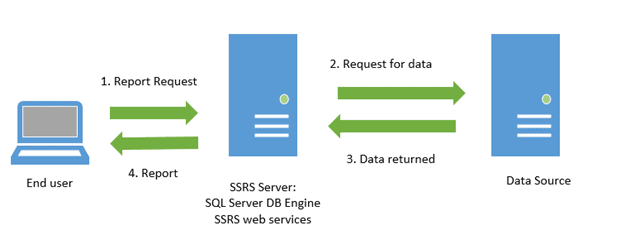
Figure i
The end user sends an HTTP request for a report, providing any required parameters. The SSRS server finds the metadata of the report and sends a request for data to the data sources. The data returned by the data sources is merged with the report definition into a report. As the report is generated, it is returned to the customer.
Installing and Configuring Reporting Services
There are many ways to pattern a Reporting Services deployment for your department or company, with SharePoint integrated mode gaining popularity. However, since this series is focused on report development, it volition embrace native style only, and merely enough about installation and configuration to help yous become things set upwards on your development computer.
To follow along with this series of articles, you will need to install the development tool and ready upward the SSRS services. If the SQL Server media is not bachelor, you can download an evaluation copy of SQL Server 2014.
SSRS installation
When running the SSRS installation, you will need to install the Database Engine and SQL Server Reporting Services in Native manner. It is easier to install both services at one time, because you lot can choose to have the installation process configure the SSRS services for you. If SSRS is installed later, or if yous select non to configure it at installation, you lot will have to configure it manually. During installation, be sure to select these features:
- Database Engine
- SQL Server Reporting Services – Native (if installing 2008 R2, you lot'll be asked on a subsequent screen to select the mode)
- Management Tools – Basic
- Direction Tools – Complete
- Business Intelligence Development Tools or SQL Server Data Tools if available with the media you lot are using, which is dependent on the version
If given the pick, select Install and Configure.
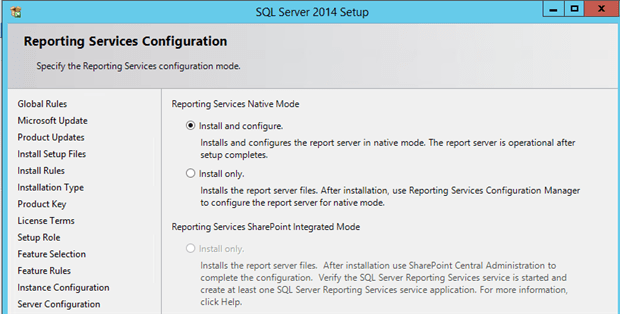
Effigy two
SSRS Development Tools
Early on versions of SQL Server used Business concern Intelligence Development Studio (BIDS) as the SSRS evolution tool. Still, starting with SQL Server 2012, you will use SQL Server Information Tools – Business organisation Intelligence (SSDT-BI), which may or may not be on the SQL Server media, depending on the version. Each tool runs every bit an add-in for Visual Studio. If you do not have Visual Studio in place, the BIDS or SSDT-BI installation volition install a Visual Studio shell.
Naming confusion?
Only to add together a little confusion, there is besides an add-in called SQL Server Data Tools for Visual Studio 2012. This is for database projects, not the BI tools that will allow y'all to create SSRS projects. It is not the option you want for SSRS development. You volition as well ofttimes run across SSDT-BI abbreviated only every bit SSDT.
The following tabular array should aid you navigate the options, sympathize the differences, and notice the correct process for installing the evolution tool for your version of SQL Server.
| SQL Server Version | Development Tool | Location of Media | Documentation |
| 2008 R2 | BIDS | SQL Server installation media | http://technet.microsoft.com/en-us/library/bb522791(five=sql.105).aspx. |
| 2012 option 1 | SSDT-BI and VS 2010 | SQL Server Installation media | http://msdn.microsoft.com/en-the states/library/ms143711(v=sql.110).aspx |
| 2012 choice two | SSDT-BI and VS2012 | Download here http://www.microsoft.com/en-us/download/details.aspx?id=36843 | http://msdn.microsoft.com/en-us/library/ms143711(v=sql.110).aspx |
| 2014 | SSDT-BI and VS2012 | Download here http://www.microsoft.com/en-united states of america/download/details.aspx?id=36843 | http://msdn.microsoft.com/en-united states/library/ms143711(v=sql.120).aspx |
SSRS configuration
If you were unable to let the installation process configure SSRS for you, or are installing SSRS afterwards the initial engine installation, or maybe you decided to configure SSRS on your ain for fun, y'all will demand to launch the Reporting Services Configuration Director.
As discussed, we demand to associate SSRS with a SQL Server instance, where it can create the reporting databases (ReportServer and ReportSereverTempdb). When prompted, select the example name and click Connect.
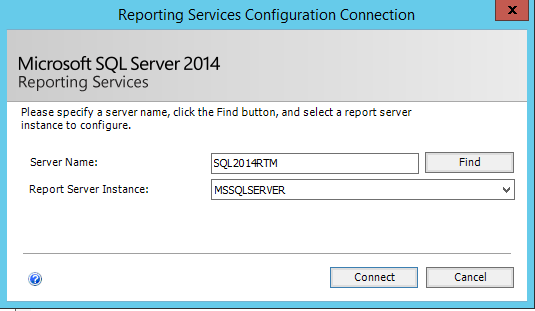
Figure iii
On the next screen, select the Database page on the left menu and click Change Database.
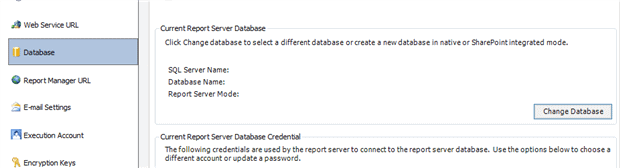
Effigy 4
Select Create a new report server database and click Next. Enter the proper noun of the SQL Server case where y'all wish to create the reporting databases and click Next.
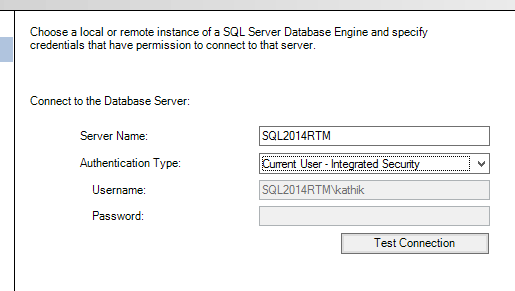
Effigy five
On the post-obit screen, we configure the report databases. We tin choose a different proper noun from the default of ReportServer, if desired, but just do so if y'all accept a skilful reason such equally multiple instances of Reporting Services on the same server.
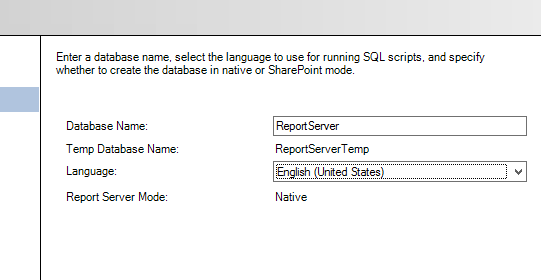
Figure 6
Continue clicking though the wizard and complete it. Once done, we need to configure the Report Server Spider web Service, then click the Web Service URL link.
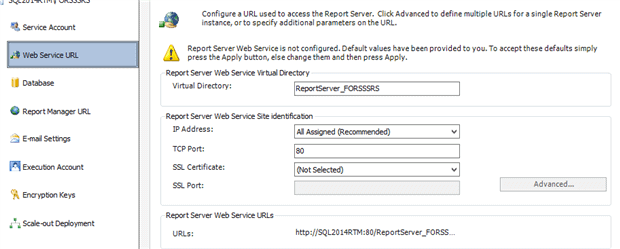
Effigy 7
Accept the defaults and click Apply. Finally, we need to configure Report Manager, so click the Study Manager URL link. Again, accept the defaults and click Utilise.
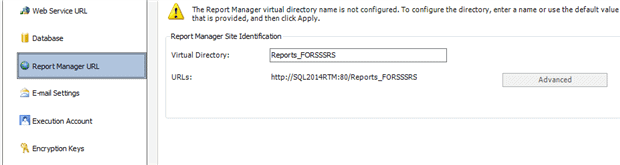
Figure 8
Click Exit to dismiss the Reporting Services Configuration Director.
Creating Bones Reports
Now that we're all set upwards, it'due south time to start building our beginning report. We're going to build a report based on a ReportingDemo database. If you desire to follow along, building the example study from scratch and so you'll demand to create the database using the ReportingDemoDatabaseScript.sql script or, alternatively, by restoring the ReportingDemo.bak file, both of which you will observe in the code file for this commodity (come across the Code Downloadlink at the finish of the commodity).
Alternatively, the download bundle too contains a re-create of the completed SSRS project, FirstProject.
Using the Report Wizard
There are 2 ways to create SSRS projects within SSDT-BI. We can build the project manually, or we can get a kicking starting time with the Report Sorcerer. Inside the project we can create i or more reports. For instance, nosotros might have one project for all of the reports against a item database, only that is not a requirement.
With the wizard, nosotros can create but a relatively simple report, with ane tabular array or matrix data region containing text only.
Mostly, the reports we create through the wizard won't meet whatsoever but the most basic development requirements, just do not discount information technology entirely. Information technology will allow us to get a written report up and running with zero code and zero belongings setting, and the resulting report often makes a starting point for more than complicated reports. Once we've created a report with the Report Wizard, we are free to modify it farther as we wish, just as for a study nosotros create from scratch, manually.
Our very beginning report projection, FirstProject, demonstrates how to create a report with grouping levels including one of the dynamic features, collapsing and expanding sections. The report is essentially just a list of customers that we'll group by country. The finish result is not perfect, but it is a good start.
Open up SSDT-BI and create a new project. Select the Report Server Projection Sorcerer type. This volition open up the New Projection dialog. Create a new Reporting Services projection called FirstProject. Click OK to showtime upward the new report wizard. We tin also kick off the wizard from within an existing project by right-clicking the Reports folder in Solution Explorer and selecting Add New Report.
The offset dialog of note is Select the Data Source. Since this is our first information source, our only option is to create a new one.
Embedded versus Shared Data Sources
For the sake of this example, we volition merely create a new, embedded data source, which will be available but to the study in which it is embedded. Nevertheless, a shared database source is available to all reports within a project, and once deployed, to whatsoever deployed report, from whatever project. If an existing shared data source exists, nosotros should use it, and we have the option on this screen to make the electric current data source a shared data source. We're going to set up a shared information source after in this article.
Select the New data source radio button and give the data source a proper noun, usually referring to the database name, so in this case ReportingDemo. Get out the data source type as the default (Microsoft SQL Server).
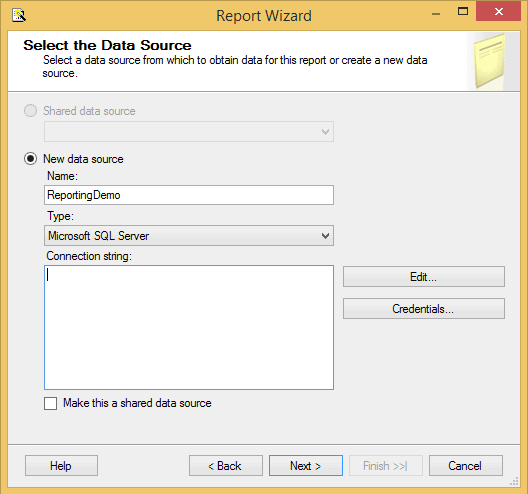
Figure ix
Click the Edit button to bring up the Connexion Backdrop dialog. Enter the name of the SQL Server instance hosting the data source, in this case the ReportingDemo database. The default option is to log on using Windows Authentication. If you are using SQL Server Authentication, choose that setting, and enter the username and countersign. Finally, select ReportingDemo and make sure y'all test the connectedness earlier yous click OK.
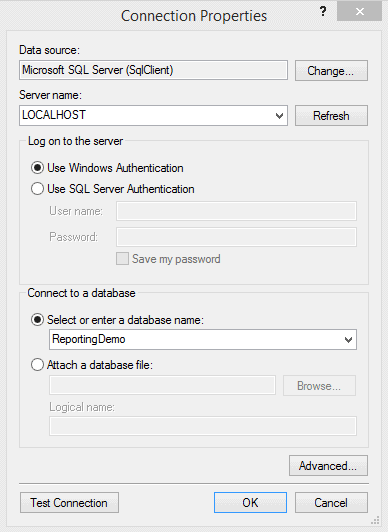
Figure ten
Next up is the Pattern the Query screen. We can use the Query Builder past clicking the button at the top left but, in this case, simply enter SELECT * FROM Customer; into the Query cord text box and click Next.
On the Select the Written report Type dialog, we can choose between a tabular or matrix report. A tabular report is a traditional grid with column headings and rows of data, and it might contain grouping sections at the row level. A matrix study is like a pivot table. It tin have column headings that expand beyond the top of the report. It tin have grouping sections at the row and column levels. Nosotros're going to start with a simple tabular written report so choose Tabular and hit Next.
This brings upward the Design the Tabular array screen, where we specify what customer data nosotros wish to include in our report, and how we wish to group information technology. Substantially, we need to specify how we will use each field (column) in the study. Nosotros might brandish some fields at the top of each page, use others for grouping, and others will grade the detail level of the report.
In this case, we simply want to group the client data by country, and so select Land in the Available fields box and click the Grouping push. If you grouping by more i field, then make sure the fields are ordered (use the Up and Down arrows) to reflect the group level hierarchy you wish to meet in the report. For example, State would be higher than City.
Add the other fields to the Details box.
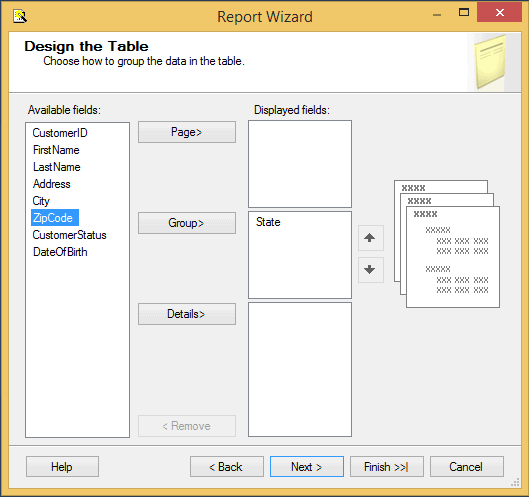
Figure 11
On the Choose the Tabular array Layout page, we have the option of Stepped or Block. I don't see a lot of difference between these layouts. After some experimentation, I plant that the Stepped written report had a row dedicated to the grouping label and that row was formatted with a background color. The Block study shows the group label on the beginning row of the particular and no special background. With the Block study, we practice not have the option for drilldowns.
Select the Stepped option and check the Enable Drilldown checkbox, which will allow the states to collapse and expand the data past state (the grouping cavalcade)
On the next screen, choose a style for your report (I chose Ocean).
The Choose the Deployment Location screen allows us to specify the Report Server to which we wish to deploy the reports in the project. For now, we volition exist working inside SSDT-BI and not deploying the reports to the server, then we can only take the defaults. When we are ready to deploy the reports, we can revisit these settings by right-clicking the projection proper name and selecting Properties.
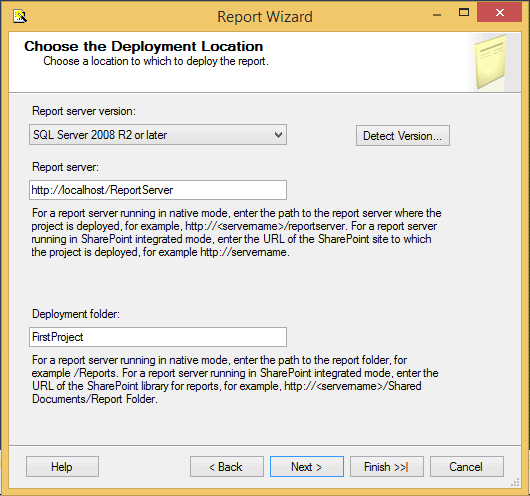
Figure 12
This brings upwards the terminal screen, Completing the Wizard, which simply summarizes our chosen written report options, and lets u.s.a. proper noun the report and preview information technology. Name the written report ReportWZ and click Finish to end the wizard.
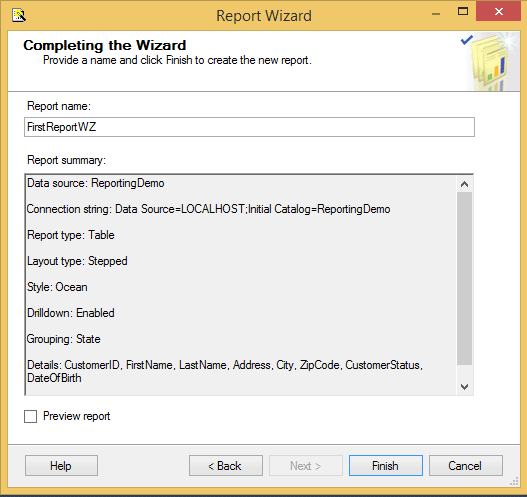
Figure thirteen
After the wizard completes, we will see the report in the Blueprint tab of the standard Report Designer.
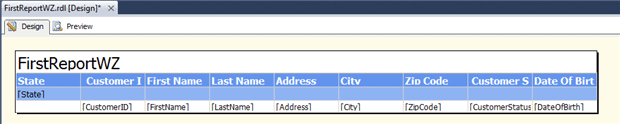
Figure fourteen
Click on the Preview tab to view the report. The Preview tab allows the states to run the study from SSDT-BI, without having to publish it offset to the Report Server. If the written report takes parameters, the Preview tab will ask the states to fill them out before it runs the report. Since this study doesn't accept any arguments, it will display immediately.
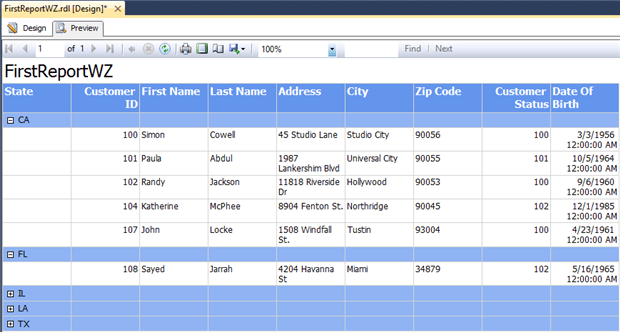
Effigy 15
Utilize the +/- symbols next to the State abbreviations to expand and collapse the group of the report.
Transmission study creation
Whilst the FirstReportWZ report is simplistic, it does demonstrate how speedily nosotros tin generate reports using the Wizard, which is frequently useful for prototyping.
In this section, we are going to create another simple, but more realistic, study from scratch. Information technology volition demonstrate how to create and employ a shared data source object, stored procedures, and how to format the report, set report properties and use written report parameters.
Create a shared information source
A shared data source is a information source that is common to, and tin can be used by, all of the reports in the project. Once the shared information source is published to the study server, whatsoever published reports can utilise it.
In the previous section, nosotros created a Written report ing Demo data source that is embedded in the ReportWZ report, and so is available merely to that report. However, generally, it is a bad practice to use embedded data sources. Let'south say we have xx reports that access the ReportingDemo database, but a few months later some aspect of the connection data changes (such as the login credentials, or server name). Nosotros'll accept to open all xx reports and edit the connexion information appropriately. Information technology is much better to define a unmarried shared data source that all reports that need the ReportingDemo database can use.
Likewise, let's say that our system has deployed three SSRS sites: Development, Test and Product. If we embed the connexion information in the report, we will take to alter the data source backdrop each time we publish the report to Evolution, Test or Production. If we utilize a shared data source, the data source will be configured appropriately on each of three sites. Nosotros tin can configure a information source on each site with the same name only pointing to the advisable servers. We can merely publish the reports to each site, and the reports will automatically utilise the connection data associated with that environs.
Nosotros can discover in SSDT-BI's Solution Explorer all the reports and other project-level objects. To add a new shared data source to the project, correct-click on the Shared Data Source s folder and select Add New Data Source and then just create a ReportingDemo data source exactly as described in the previous section. Information technology's not possible to edit the existing embedded information source to make it a shared ane. Nosotros have to ascertain information technology as a shared data source upon cosmos.
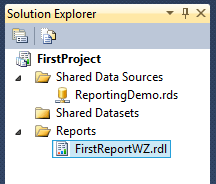
Figure 16
Add a new report
Nosotros're now going to create some other written report to return customer information. In the previous example, we used a simple SELECT * query to ascertain the data ready for the report. Here, we'll use a stored procedure. In this first example, we'll use a bones stored procedure with no parameters, just afterwards we'll refine information technology to add parameters, and allow finish users to filter the written report data past parameter value (east.g. to view customers but from a detail state).
When creating a new report manually, we must always follow this sequence of steps before we tin brainstorm to add information-connected objects:
- Add the study
- Create a data source in the report, preferably pointing to a shared data source
- Create a dataset that points to the data source and contains your query
Beginning we add the written report to the project. From the carte select Projection | Add New Detail (or correct-click on FirstProject in solution explorer). Select Report, proper name it FirstR eportMan.rdl and click Add. The new report will open up in Report Designer tool, at the Blueprint tab.
Second, we ascertain the database for the FirstReportMan study. On the left, y'all will run into the Report Data window, used to manage the data sources, datasets and parameters of our written report. At the pinnacle of the Report Data window, cull New | Data Source… from the dropdown list, which will open the Data Source Properties window, where we can either create a new embedded data source or point to a shared data source. We'll change the proper name of the data source to ReportingDemo and select the Utilize shared data source reference pick, selecting the ReportingDemo shared data source from the dropdown list.
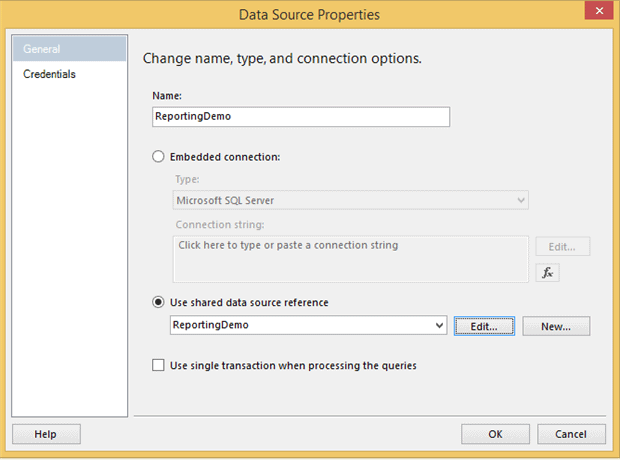
Figure 17
Tertiary, nosotros create the Dataset. While the data source is the connexion string, the dataset is the query definition. In this instance, our dataset is a very simple, parameter-less stored procedure chosen spr_CustomerSelectAll and all it does is select all of the columns from the Customer table. The ReportingDemoDatabaseScript.sql script, in the code download, includes the code to create the stored procedure.
From the Written report Data card, cull New | Data Set… to open the Dataset Properties dialog. We can create a shared dataset or a dataset embedded in the written report. Near of the time, the dataset will be embedded in the written report. In that location are some exceptions to this, for example, when we have a parameter list we use in multiple reports. Name the dataset Customers and choose to embed the dataset in the report. Select the ReportinDemo data source from the dropdown. Select StoredProcedure as the command type, and choose spr_CustomerSelectAll in the stored procedure listing.
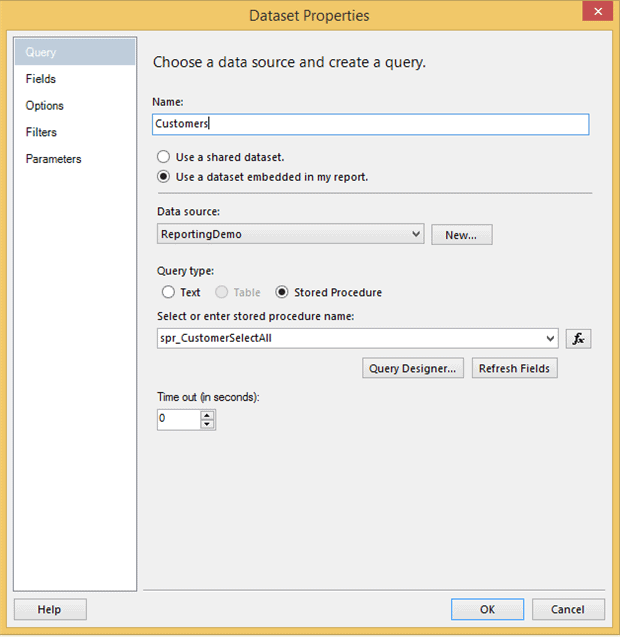
Figure xviii
We can repeat these steps to add multiple datasets to the report, but for now we only demand the one.
Designing the written report
As nosotros've noted previously, at the top of the Written report Designer window are ii tabs: Blueprint and Preview. The Design tab is the physical Report Designer where nosotros design the report i.e. prepare the information presentation of the report itself, plus whatsoever header and footer for the report pages.
Design the Study table
Let'south start by designing the basic report table. Click to Blueprint tab of our FirstReportMan study. Nosotros're going to build a tabular study, and so we offset by dragging a Table control from the Toolbox window, onto the body of the report. By default, the tabular array shows a header row at the acme, and a information (or item) row at the bottom.
In the Report Data window, expand the Customers dataset, select FirstName and drag it to the first cell of the item row of the table, then drag LastName into the second column, and CustomerStatus into the third. When we drag each column into the information row of the table, SSRS make a guess equally to what to phone call the row in the corresponding header. We can expand and shrink the size of the columns past highlighting and dragging.
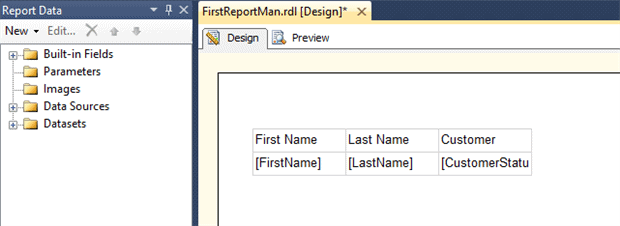
Figure 19
We tin can add together additional columns to the table by right-clicking on one of the columns and selecting one of the two Insert Column options. We'll add together the DateOfBirth column to the written report, and so add together a new column to the right of CustomerStatus, and then drag the DateOfBirth field from the dataset to the detail row of the new column. Alternatively, we can hover over the cell to see a popup listing of fields from the dataset, and select D ateOfBirth
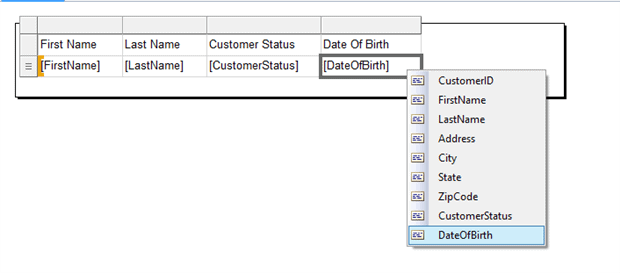
Figure 20
At this stage, we tin can click on the Preview tab to view the report.
Format the table header
Now we have a basic, very plain, tabular report, so let's add together some formatting to make it await better. We accept lots of options such as calculation background colors, changing the font or text colour, adding italics or bolding, and more. In this instance, we will modify the background colour of the header row.
To format all the cells in the header in the same mode, click 1 cell to make the tabular array handles appear. And so select the unabridged row by selecting the handle:
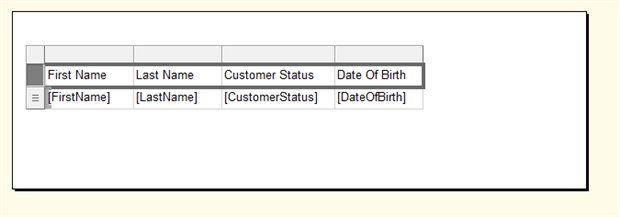
Figure 21
There are ii ways to modify the backdrop. The offset is to open up the Properties window (F4), where we tin can ready background color, font, and then on. The other method is to apply the formatting toolbar. Whichever way yous choose, set up the background color for the headers to your preferred color and choose the bold font way.
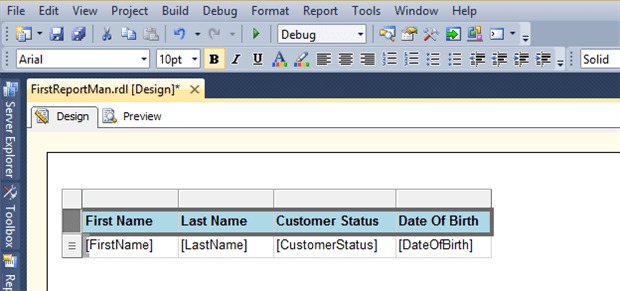
Effigy 22
Having formatted the header row, we can once more click on the Preview tab to view the report.
Add together a Folio header
Nosotros've worked on the table header, but the report page itself can as well take a header and footer. Report headers and footers appear on every folio of the report. To add one, motility to Design mode and select Report | Add Page Header from the carte. A new ring appears on the report above the trunk. From the toolbox, drag a text box onto the header, click on it and enter your header, "My First Study". Select the textbox and modify the font and text style, every bit desired. Once more, we can check our handiwork in Preview style.
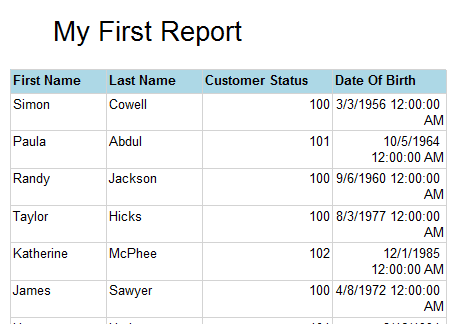
Figure 23
Starting with the 2008 release, likewise as applying formatting to a textbox, we can also apply multiple formats to the text within a textbox. Clicking the edge of the textbox selects the textbox. Clicking within the textbox selects the text. To try this, become back to the design view and select just role of the text in the "My First Report" textbox and utilize different formatting, such every bit a dissimilar font. Now there are two formats within one textbox.
Field Formatting
Nosotros tin can apply formatting to each detail field in the report table. Permit'southward start past beautifying that ugly DateOf Nativity field. The time information is superfluous, and then permit's format the date properly. Right-click on the cell that contains the date of birth, choose Text Box Properties. Side by side, navigate Number | Date and then set the preferred format (I used yyyy -mm- dd).
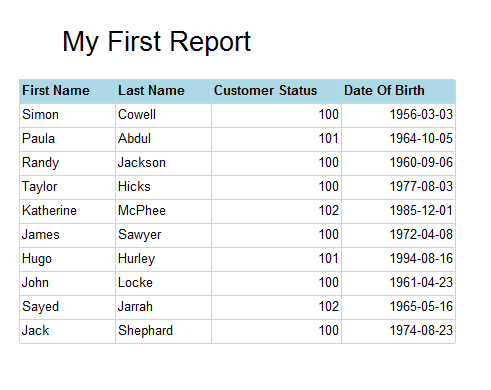
Figure 24
Setting report level properties
When on the Design tab of the Report Designer a top menu item, Report, activates, from where we tin:
- Turn on and off the header and footer sections for the report pages
- Open the Report Properties dialog and fix diverse written report backdrop, such every bit the print format
- Publish written report parts – starting with 2008 R2, yous tin can publish individual part of the study that tin can be used to build dashboards (we won't cover this till after in the serial)
- View the group section and ruler. For example, if the ruler is not visible, turn it on from Report | View | Ruler.
Navigate Report | Report Backdrop to open up the Report Backdrop dialog. Some of the written report properties are also available in the Properties (F4) window likewise, but you may find that working in the Report Backdrop dialog is more convenient.
Setting up the report print settings is not intuitive, compared to other products. In the report Pattern tab you lot see your report with a ruler across the superlative. Since I am in the United states, my ruler is prepare in inches by default. A standard sail of newspaper is viii.five ten 11 inches. The default setting in SSRS is to accept a 1-inch (or ii cm) margin all the style effectually the content surface area. And so, at 8.5 inches wide with a 1-inch margin on the left and another on the right, nosotros take 6.5 inches for content. If the report page is wider than 6.5 inches, it will spill over onto a second sheet of paper when printed. If there is just blank infinite in the extra area, you will get alternating blank sheets of newspaper when printed.
On the Page Setup tab of the Report Backdrop dialog, we can change the study to Mural if we wish, switch to centimeters, modify the paper size or the margins. To avoid spill-over when printing, make certain that the width of the report plus the right margin plus the left margin is less than the width of the paper size.
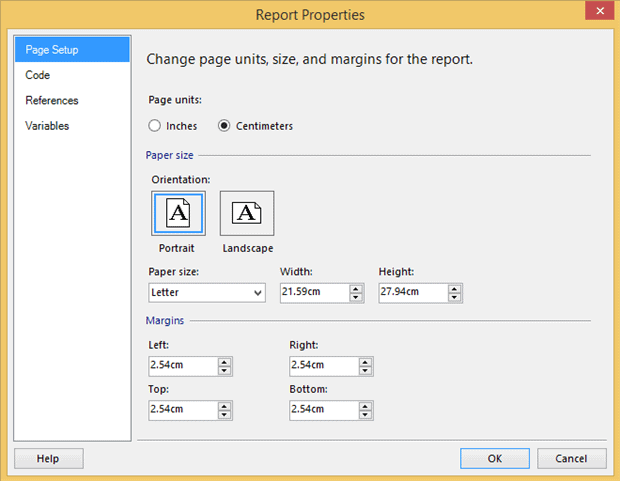
Figure 25
Calculation parameters to a written report
There are two ways to add parameters to our reports. The get-go is simply to define parameters in the queries in the dataset, then these volition automatically be available every bit report parameters. The 2nd way is to manually add written report parameters through the Parameters department of the Report Information window.
We can use parameters to filter the information at the source, or for other reasons like giving the end-user control over one of the properties. We could as well have a parameter that is used for both functions.
Parameters created by the dataset query
Kickoff, we will set up parameters using a dataset query. Yous can either continue working with the same written report or create a new one that is a re-create of the original.
To create a copy, right-click on FirstReportMan in the Solution Explorer and select C opy . Then correct-click on the projection proper name and select Paste. Rename the new report ParameterReport. Double-click the new written report in Solution Explorer to open it in the designer. In the Report Information window, navigate to the Customers dataset and double-click it to bring up the properties. The Dataset dialog box opens and allows united states to edit the query for the dataset. Change the stored procedure from spr_CustomerSelectAll to spr_CustomerSelectByState. A parameter called @ StateCD should appear in the Parameters folder. This parameter allows us to filter the data from the Customer table past State. Once again, the ReportingDemoDatabaseScript.sql script in the code download includes the creation script for spr_CustomerSelectByState.
Switch to the Preview tab to view the report. Instead of the study only running and displaying all the data from the information source, there should be a place for us to enter a value for the @ StateCD parameter. Enter "CA" and click the View Study push button to see only Californian customers.
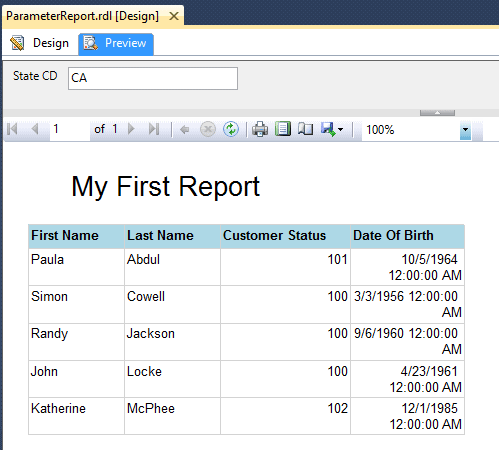
Figure 26
To edit existing parameters, or to add together new ones, switch to the Design tab of the Report Designer and expand the Parameters folder. Double-click the StateCD parameter to bring up the properties. First, we are going to brand the prompt a petty more friendly. On the General page, alter the Prompt value to State.
We tin can as well provide a list of possible values for the parameter. Select the Available Values page and from hither we tin can provide either a hard-coded list, or connect the parameter to a dataset. The second method is the by and large the best so that nosotros tin can avert the demand to maintain the list manually.
Close the parameter properties. To connect a parameter to a dataset, nosotros first demand to create a new dataset. Using the skills y'all accept learned then far, add together a dataset to the report called StateList based on this query: SELECT Singled-out State FROM Client Lodge BY Land ; .
Open up the parameter properties once more and select Available Values. Cull Get values from a query. Under Dataset, select StateList. For the Value and Label fields, select Land.
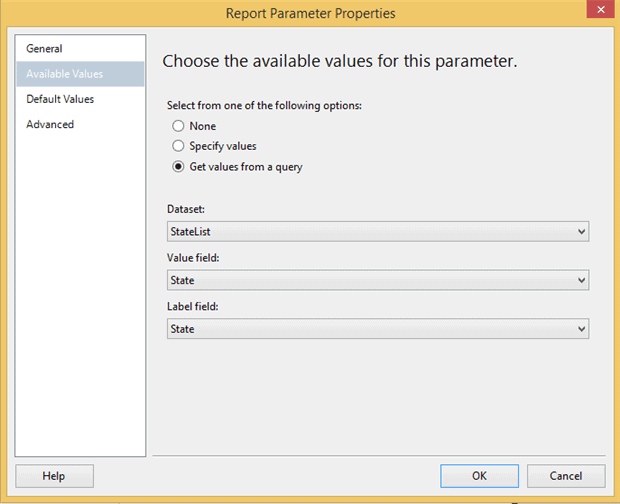
Figure 27
In this case, the Value and Characterization fields are the same. The Value field is the field that the database needs for the query. The Label field is the field that the end user should see. For example, if we have a listing that has an ID and a clarification, the ID would be the Value field while the clarification would be the L abel field.
Manually created parameters
Tip: Shared data sources, embedded datasets
Generally, data sources are best shared and datasets are best embedded. However, queries to populate parameter lists are good examples of datasets you may desire to share instead, since they can ofttimes be used for several reports.
At present let's add a parameter that is not defined in a query and, therefore, must exist created manually. In the Written report Data window, click Add together | New Parameter. Requite the new parameter the proper name ReportTitle, and enter "Report Championship" for the Prompt. Its data type should be Text. Click OK.
Back on the Design tab, right-click the report header textbox and choose the Expression option. Remove the original "My Get-go Report" text and select Parameters nether Categories. Double-click on the ReportTitle parameter. This text box will now brandish the value we pass to the Report Title parameter. Click OK.
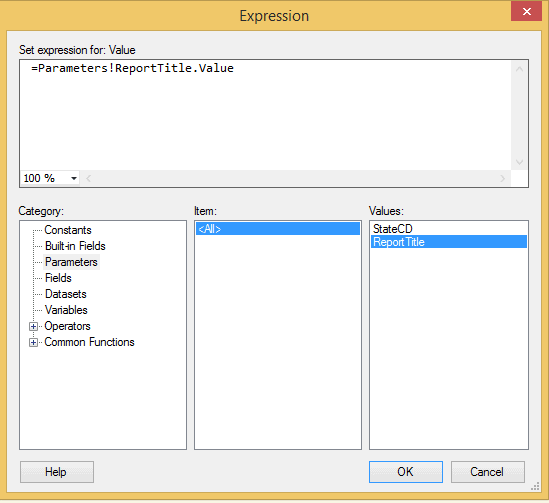
Figure 28
Switch to the Preview tab and endeavor it out.
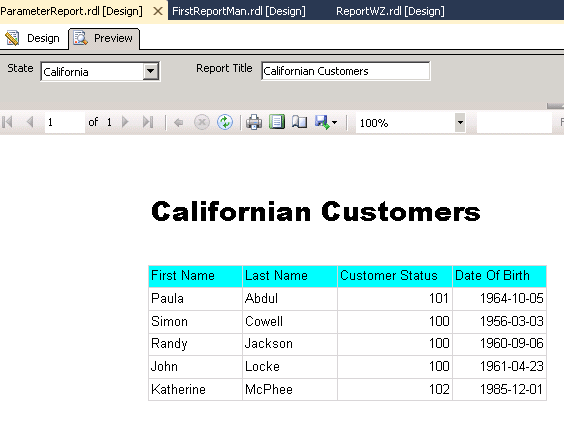
Figure 29
Wrap upwardly
Part 1 covered everything we need to build a bones SSRS report. In the side by side articles, we'll get into more than advanced options such as grouping, drill-downs, sorting and custom functions. Stay tuned.

How To Hard Reset Sql Reporting Service,
Source: https://www.red-gate.com/simple-talk/databases/sql-server/bi-sql-server/sql-server-reporting-services-basics-building-ssrs-reports/
Posted by: joestagazen.blogspot.com
0 Response to "How To Hard Reset Sql Reporting Service"
Post a Comment